Target group: computer scientists at the university.
Approaching computer scientists on campus.
With 251 universities and over 260,000 enrolled computer science students, Germany as a higher education location is among the most important training sites for tomorrow’s IT professionals.
Early-career academics benefit at the university from a unique mix of disciplinary diversity, practice-oriented teaching, and modern campus life. Renowned universities and universities of applied sciences shape the educational landscape: from long-established computer science faculties at large universities to technical universities with a strong focus on application, all the way to specialized institutions geared toward future-oriented fields such as artificial intelligence, cybersecurity, or data science.
Position your company early on in the race for emerging computer science talent, who after graduation will play a key role in shaping companies, public institutions, and research organizations.
This is the target group of computer scientists.
260,000 out of 2.864 million: Statistically speaking, every eleventh student in Germany is enrolled in a computer science degree program. Every year, more than 39,000 first-year students begin the adventure of university studies; almost as many also complete their studies that year and enter the job market.
When it comes to the gender distribution, unlike the national average where there are about as many female as male students, the field of computer science is firmly in male hands! The proportion of women in this technical discipline is only just over 23%.
Computer scientist is not the same as computer scientist
Computer science students are not all the same. Within the field of study, there are various degree programs: the most popular is the Computer Science program, in which 152,472—more than half of all students in the field—are enrolled. In Business Informatics, the second most popular program, 68,809 students are enrolled. The degree programs Technical Informatics and Media Informatics each account for just under 16,000 students. There are major differences in the dropout rate between universities and universities of applied sciences. The cohort examined was the first-year intake of the 2016/17 winter semester, and it was compared how many were still enrolled in the program by the likely bachelor’s graduation year in 2020. The result: while 30% drop out at universities of applied sciences, it is 42% at universities.
| 267.249 | Computer science students |
| 9,3 % | of all students in Deutschlan |
Sources: Statistisches Bundesamt (WS 2024/25) • DZHW student dropout study 2022
| Location | Hochschule | Students | |
|---|---|---|---|
| 1 | Hagen | Fernuniversität Hagen | 12.591 |
| 2 | Erfurt | IU Internationale Hochschule Erfurt in Erfurt (Private ) | 10.493 |
| 3 | München, Garching, Weihenstephan | TU München in Munich, Straubing, Garching and Weihenstephan | 8.855 |
| 4 | Stuttgart | Baden-Württemberg Cooperative State University, Stuttgart (FH) | 6.656 |
| 5 | Darmstadt | TU Darmstadt | 5.245 |
| 6 | Aachen | TH Aachen (U) | 5.062 |
| 7 | Duisburg, Essen | U Duisburg-Essen | 4.946 |
| 8 | Berlin | TU Berlin | 4.876 |
| 9 | Dortmund | TU Dortmund | 4.140 |
| 10 | Gießen, Friedberg, Wetzlar | Technische Hochschule Mittelhessen (THM), FH | 3.871 |
| 11 | Karlsruhe | Karlsruhe Institute of Technology (KIT), University Sector (U) | 3.654 |
| 12 | Munich | U München | 3.458 |
The largest universities for computer scientists!
In Germany, 1,899 degree programs at 251 higher-education institutions are currently assigned to the field of study Computer Science. This makes Computer Science one of the largest and most diverse fields of study in the country and offers companies broad access to aspiring computer scientists at various higher-education institutions.
Measured by the number of enrolled students, higher-education institutions with distance-learning offerings are clearly at the top. Die FernUniversität in Hagen leads the ranking with 12,591 enrolled Computer Science students, closely followed by the Internationalen Hochschule Erfurt with 10,493 students. These institutions reach computer scientists throughout Germany regardless of the traditional campus.
The most important on-campus universities for computer science
Among the universities with a physical campus, the Technische Universität München (TUM) is the largest training institution for computer scientists in Germany. With 8,855 students, it leads the field, followed by the Duale Hochschule Baden‑Württemberg with 6,656 and the TU Darmstadt with 5,245 computer science students. At the ten largest on-campus universities alone, more than 50,000 computer science talents can thus be reached directly on campus. Across all universities, the average is just over 1,000 students per location.
| Location | Students | |
|---|---|---|
| 1 | Berlin | 15.593 |
| 2 | Munich | 15.255 |
| 3 | Stuttgart | 12.675 |
| 4 | Darmstadt | 9.138 |
| 5 | Duisburg, Essen | 8.444 |
| 6 | Dortmund | 7.720 |
| 7 | Aachen | 6.860 |
| 8 | Hamburg | 6.477 |
| 9 | Frankfurt am Main | 6.392 |
| 10 | Karlsruhe | 5.497 |
94,000 computer scientists in the ten largest university cities.
Around 94,000 students—representing 35 percent of all enrolled computer science students in Germany—are concentrated in just ten university cities. Leading the way is the country’s largest university hub: Berlin. Here, 15,593 computer science students are enrolled at renowned institutions such as TU Berlin, HTW Berlin and the Freien Universität Berlin.
Close behind is the Bavarian state capital Munich with 15,255 students, who are educated at excellence campuses such as TU München and LMU München. Another key hotspot for recruiting computer scientists is Stuttgart: Across the city’s seven higher-education institutions—including the Duale Hochschule Baden‑Württemberg, the Universität Stuttgart and the Hochschule der Medien—a total of 12,675 computer science students are enrolled.
Sources: Statistisches Bundesamt (WS 2024/25) • Hochschulkompass 2026
WiWo Ranking 2025
At which universities do tomorrow’s computer scientists study—those who are particularly in demand on the job market? WirtschaftsWoche explores this question in its renowned university ranking. The ranking provides a labor-market-oriented overview of which universities and universities of applied sciences are especially highly regarded by recruiters and on which campuses companies prefer to look for qualified computer scientists.
Ranking for Computer Science and Business Informatics
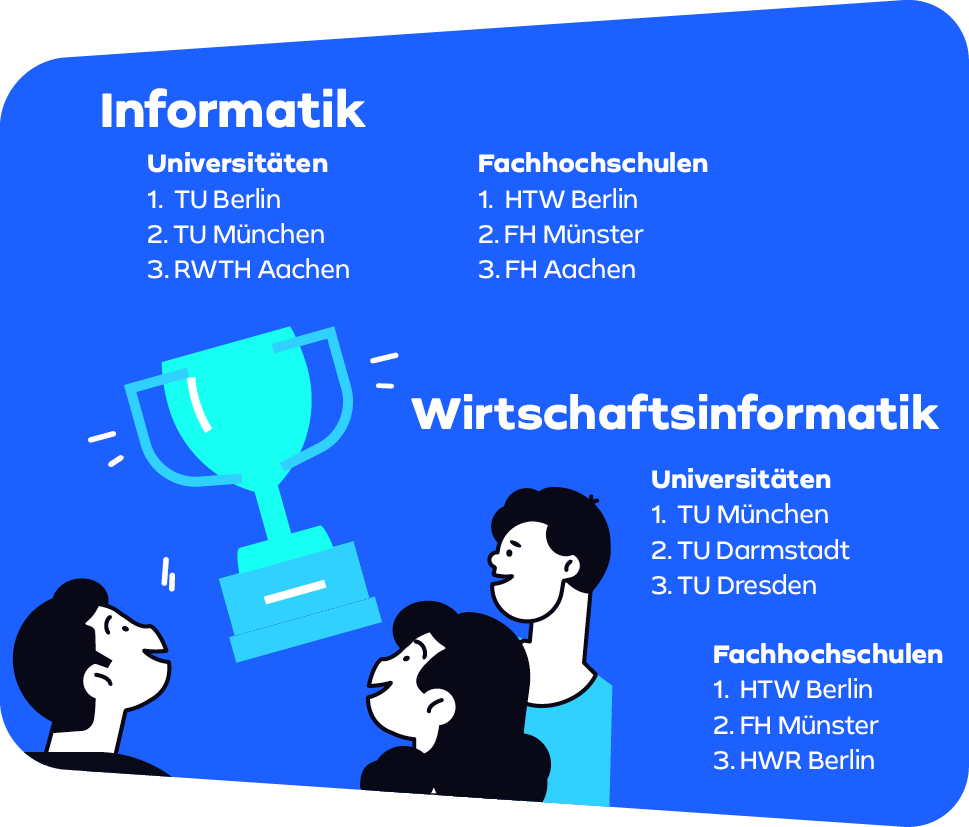
In the field of study Computer Science, Berlin’s higher-education institutions are considered the benchmark. No fewer than three universities and three universities of applied sciences from Berlin make it into the top‑5 positions. The front-runner among the universities is theTU Berlin, while among the universities of applied sciences HTW Berlin takes the top spot. It is also striking that both in second place (TU München and FH München, respectively) and in third place (RWTH Aachen and FH Aachen) two institutions from the same city are represented in each case – a clear signal of particularly strong computer-science locations.
In the field of study Business Informatics, too, well-known institutions dominate the top ranks: TU München among the universities and HTW Berlin among the universities of applied sciences lead the field. At the same time, the ranking shows that sought-after computer scientists do not come only from a few leading institutions. Universities such as TU Darmstadt, TU Dresden, the Universität zu Köln and the Goethe‑Universität Frankfurt, as well as universities of applied sciences such as the FH Dortmund and the TH Köln, are also among the top‑5 addresses for practice-oriented training of computer scientists at German higher-education institutions.
Approach computer scientists at the university –
Discover our media now!