
Digital menu guidance system
CloudMensa: The digital menu guidance system for Cologne Student Services Organisation
CloudMensa takes the digital menu guidance system in Cologne’s cafeterias, coffee bars and bistros to a new level.
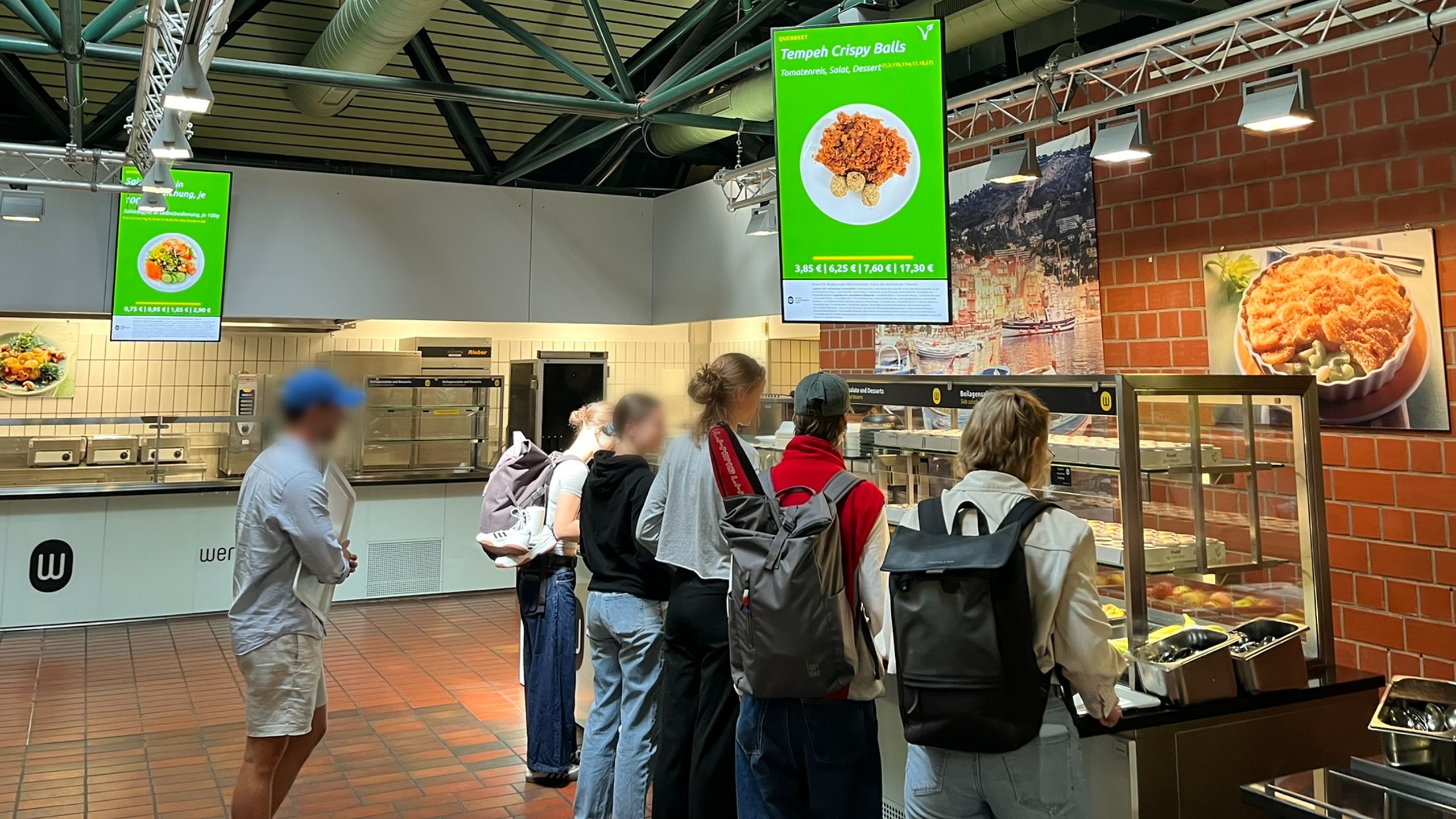
With the introduction of CloudMensa , Cologne Student Services Organisation has comprehensively modernised its digital menu guidance system, setting new standards in university catering. Around two million meals are served annually across 17 locations in Cologne, Gummersbach and Leverkusen. This is a scale that places high demands on both organisation and communication. CloudMensa addresses precisely this challenge, combining centralised control with maximum flexibility on site.
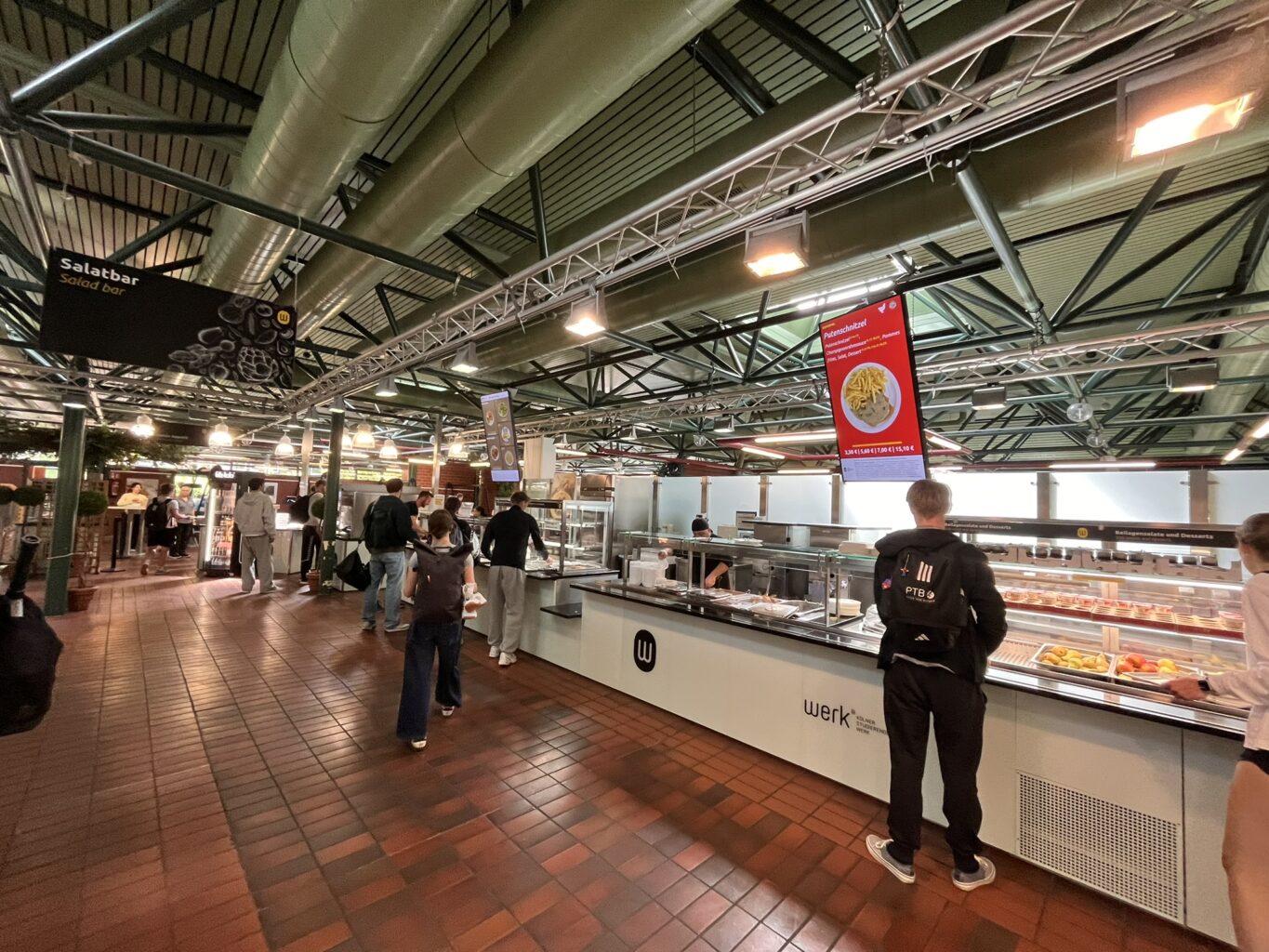
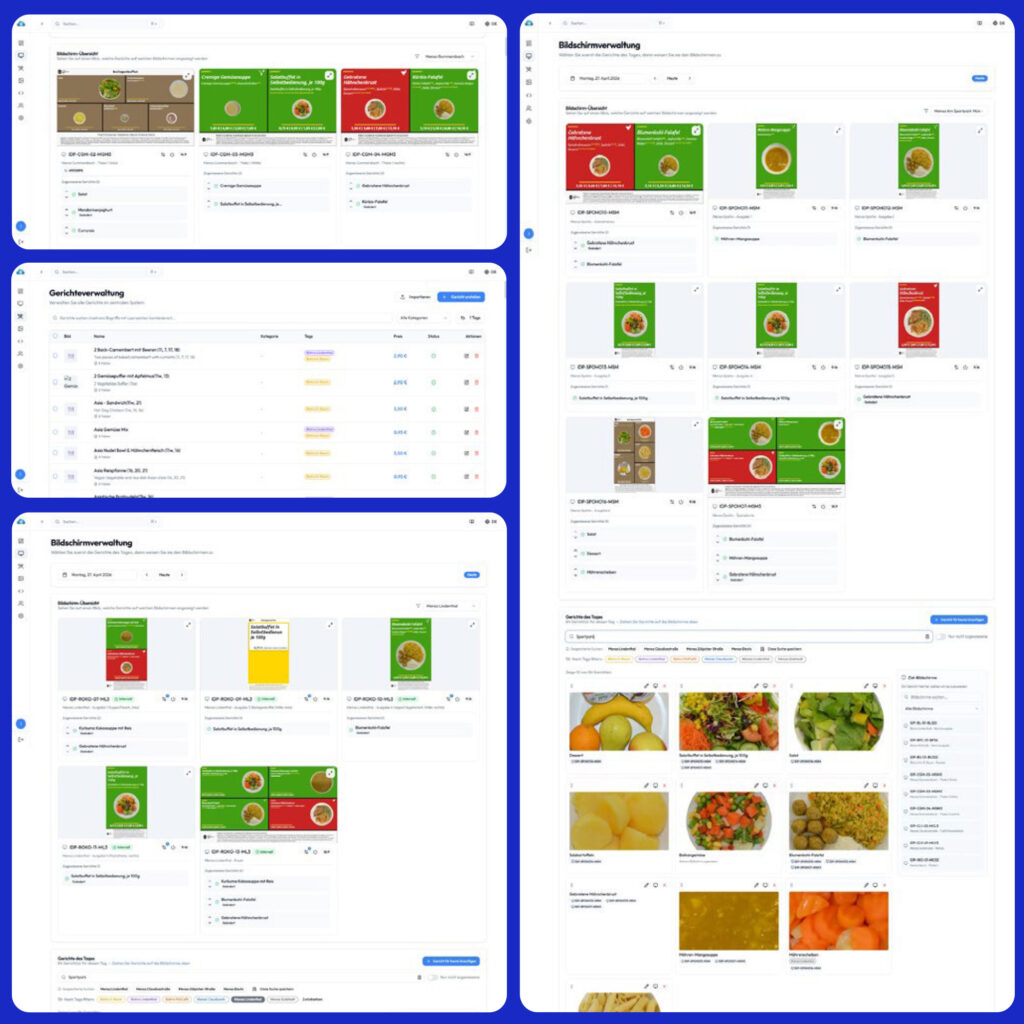
The challenge: menus need to be kept up to date, tailored to their target audiences and distributed to specific locations as efficiently as possible. With CloudMensa, content is managed centrally while also being tailored to individual cafeterias, bistros or coffee bars. Changes are synchronised automatically and appear on screens, websites or mobile devices at scheduled times. Cologne Student Services Organisation uses a total of 54 screens, ensuring consistent digital communication with its guests.
This project particularly demonstrates the system’s scalability: CloudMensa is suitable for both large organisations with complex infrastructure and smaller businesses. Extensive menu data can be imported directly from inventory management or ERP systems—an important advantage for large institutions with established processes. At the same time, the platform also allows dishes to be entered manually, as is still common in smaller bistros and coffee bars.
This flexibility makes CloudMensa a solution that adapts precisely to different business sizes and ways of working. While large teams benefit from clearly defined roles and permissions, the intuitive user interface also enables smaller teams to get started quickly without lengthy training.
The practical experience in Cologne confirms this approach: centralised control significantly reduces administrative work while preserving the individuality of each location. Time-of-day content, promotional notices and last-minute changes can be easily incorporated and targeted to the right audience. This is an important factor in a dynamic catering operation.
The implementation at Cologne Student Services Organisation impressively demonstrates how a modern digital menu guidance system can meet the needs of a large university catering operation while still offering sufficient flexibility for smaller units. CloudMensa is thus positioned as a comprehensive solution for anyone looking to make their menu communications digital, efficient and future-proof.
The example from Cologne shows how a modern digital menu guidance system works even in highly complex settings. But what exactly is a digital menu guidance system, what types are available, and what should student services organisations in particular consider when choosing one?
»After Berlin and Munich, Cologne is Germany’s third-largest university location: more than 120,000 students study in the cathedral city and want good food during breaks between lectures and seminars. Cologne Student Services Organisation is the central point of contact here and an ideal opportunity to demonstrate CloudMensa’s capabilities.«

Ioannis Voudouris, �
Managing Director
Deutsche Hochschulwerbung
»As a student services organisation with many cafeterias and bistros, maintaining menus was always an organisational challenge.
CloudMensa has fundamentally changed that: centralised control and location-specific adjustments are no longer mutually exclusive—updates happen automatically, and the system is so intuitive that our employees were able to use it productively right away.«

Mareike Wiggers, �
Head of Catering
Cologne Student Services Organisation
What is a digital menu guidance system?
A digital menu guidance system is a solution for communicating menus, meal options and additional information in food service settings such as cafeterias, canteens, company restaurants or hospitals. Its purpose is to show guests at a glance which dishes are available at each serving station, which ingredients and allergens they contain, and how much each dish costs.
While traditional menus are still based on printed notices, boards or flyers, modern institutions are increasingly turning to digital menu guidance systems. These combine centralised data management with flexible, location-specific display on screens, websites and mobile devices.
The benefits of a structured digital menu guidance system are particularly clear in organisations with multiple locations, high visitor volumes or frequently changing menus: it reduces maintenance effort, improves communication with guests and provides a consistent, up-to-date information base across all serving locations.
Analogue vs. digital menu guidance systems
Analogue – the traditional menu guidance system:
Many institutions still communicate menus by hand or through printed notices: chalkboards, laminated weekly menus or printed flyers at the food counter. This solution is inexpensive to set up, but has significant drawbacks. Changes to the menu, for example when dishes are unexpectedly unavailable, can only be communicated with a delay. In addition, updates have to be made manually at every location, which quickly creates a substantial organisational burden when there are multiple cafeterias or bistros.
Digital – centralised data management:
A digital menu guidance system solves these problems through centralised, cloud-based data management. Menus are entered once and automatically synchronised across all connected displays, websites or apps. Changes appear in real time without requiring on-site staff to take action. Content can also be displayed on a schedule, for example automatically showing the breakfast menu in the morning and the lunch menu at midday.
Practical tip:
When deciding between an analogue and a digital menu guidance system, compare not only the purchase costs but also the ongoing maintenance effort. Especially when multiple locations are involved, a digital system often pays for itself quickly through the administrative work it saves.
Benefits of a digital menu guidance system
Centralised control of the menu guidance system with decentralised use
Menus are maintained in one place and automatically distributed to all locations. This reduces the risk of errors and saves time, particularly in organisations with many serving locations. Instead of maintaining each cafeteria or canteen individually, a single entry in the central content management system is all it takes to supply all connected screens automatically. This delivers the greatest time savings over traditional, manually maintained notices, especially for student services organisations with locations spread across a city or region. Access permissions can be assigned in a granular way, allowing individual locations to make their own adjustments when needed without compromising the central structure.
Real-time menu updates
Last-minute changes, such as sold-out dishes or spontaneous alternatives, can be communicated immediately without printing new notices. A change made in the system appears on all connected displays within seconds, regardless of how many screens are in use. This is especially valuable during peak times, when the availability of individual dishes can change at short notice and guests might otherwise queue for items that have sold out. Seasonal or daily specials can also be added flexibly, without additional staff having to put up new paper signs.
Connecting the menu guidance system to existing systems
Many digital menu guidance systems can be connected directly to inventory management or ERP systems. This means menu data does not have to be entered twice but can instead be imported automatically. This not only reduces administrative work but also minimises the risk of data transfer errors between kitchen planning and guest displays. Standardised interfaces (APIs) can also be used to integrate cash register systems, allergen databases or accounting software, embedding the menu guidance system seamlessly into existing IT environments. This also reduces the long-term maintenance workload for kitchen and administrative staff.
Benefits of a digital menu guidance system for guests
Allergens, additives, nutritional information and vegetarian or vegan labels can be presented clearly and consistently, significantly increasing transparency for guests. Guests with intolerances or specific dietary habits can find the information they need at a glance without having to ask. Pictograms, colour coding or filter functions on interactive terminals make it even easier to find information quickly, especially in busy cafeterias. Overall, this not only increases satisfaction but also builds trust in the quality and care behind meal service.
Scalability of the menu guidance system
Digital menu guidance systems grow with your needs: whether for a single bistro or a student services organisation with more than a dozen locations, systems can be adapted flexibly to the size of the operation. New locations or additional screens can generally be integrated into the existing setup without major technical effort. This also makes the solution attractive to organisations planning to expand or extend their services to additional locations in the medium term. At the same time, ongoing costs remain manageable, as licensing and maintenance models can usually be scaled in proportion to the number of displays.
A more modern look with digital menus
Digital screens look more contemporary than laminated notices and contribute to a positive overall impression of the catering operation—something that matters particularly to younger audiences such as students. High-quality displays with appealing design signal investment and modernity, which also indirectly influences how people perceive the quality of the food on offer. The same infrastructure can also be used to display additional content such as event notices, waiting times or social media feeds, further improving the experience of the space. This turns a simple information display into a genuine design feature of the dining area.
Digital menu guidance systems at student services organisations
Student services organisations face particular challenges when serving food. Thousands of meals are often served every day at numerous locations, from large central cafeterias to small bistros and coffee bars on campus. At the same time, students are particularly price-sensitive, well-informed and expectant when it comes to digital solutions.
A well-functioning menu guidance system therefore needs to meet several requirements at once:
- Clear display of student and guest prices, as cafeterias generally have different price tiers
- Quick, straightforward maintenance by kitchen staff who may change frequently
- Multilingual display for international students
- Integration of sustainability and product-origin information, which younger audiences increasingly want
- Reliable display even at high service volumes and during the lunchtime rush
Large student services organisations with many locations in particular benefit significantly from the centralised control offered by a digital menu guidance system. Instead of updating menus individually at every location, all communications can be managed centrally, while individual cafeterias and bistros can still independently adapt their own offerings.
Implementation: From the kitchen to the screen
The technical setup of a digital menu guidance system generally follows a similar principle: menu data is entered manually through a web interface or imported automatically from an existing inventory management or ERP system. The content is then managed centrally and displayed on the relevant devices, such as screens at food counters, information screens in entrance areas or the organisation’s own website.
Modern systems allow for fine-grained control: content can vary depending on the time of day, be adapted to specific locations and synchronise automatically whenever changes are made. Roles and permissions also ensure that individual locations can make their own adjustments without accessing the central data structure.
Common mistake:
Organisations often underestimate the training required for kitchen staff. A system that is technically powerful but difficult to use is often not maintained properly in day-to-day work. An intuitive user interface is therefore just as important as the range of features.
Our FAQ about digital menu guidance systems
Introducing a digital menu guidance system is a major step that transforms existing processes. It is therefore important to be absolutely clear about the functions the system actually needs to provide. Our FAQ offers an initial overview and answers many common questions. We would be happy to discuss detailed planning in a consultation .
Eignet sich ein Speiseleitsystem auch für kleinere Betriebe?
Ja, moderne Speiseleitsysteme sind skalierbar und eignen sich sowohl für große Studierendenwerke mit vielen Standorten als auch für einzelne Bistros oder Cafeterien mit manueller Dateneingabe.
Was ist ein Speiseleitsystem?
Ein Speiseleitsystem ist eine Lösung zur Kommunikation von Speiseplänen und Zusatzinformationen in Gemeinschaftsverpflegungen wie Mensen, Kantinen oder Betriebsrestaurants. Es zeigt Gästen, welche Gerichte verfügbar sind, welche Allergene enthalten sind und was die Gerichte kosten.
Was kostet ein Speiseleitsystem?
Die Kosten hängen von der Anzahl der Standorte, der benötigten Displays und dem gewünschten Funktionsumfang ab. Üblich sind einmalige Einrichtungskosten sowie laufende Lizenzgebühren pro Standort.
Welche Vorteile hat ein digitales Speiseleitsystem gegenüber klassischen Aushängen?
Digitale Speiseleitsysteme ermöglichen Echtzeit-Aktualisierungen, zentrale Steuerung über mehrere Standorte hinweg und die automatische Anbindung an Warenwirtschaftssysteme. Das reduziert den Pflegeaufwand erheblich.
Wie wird ein Speiseleitsystem technisch umgesetzt?
Speisedaten werden manuell eingepflegt oder aus einem ERP-System importiert und zentral verwaltet. Von dort werden sie an Displays, Websites oder Apps ausgespielt und automatisch synchronisiert.
