
The impact of campus advertising
Advertising on campus works: 7 in 10 students take action
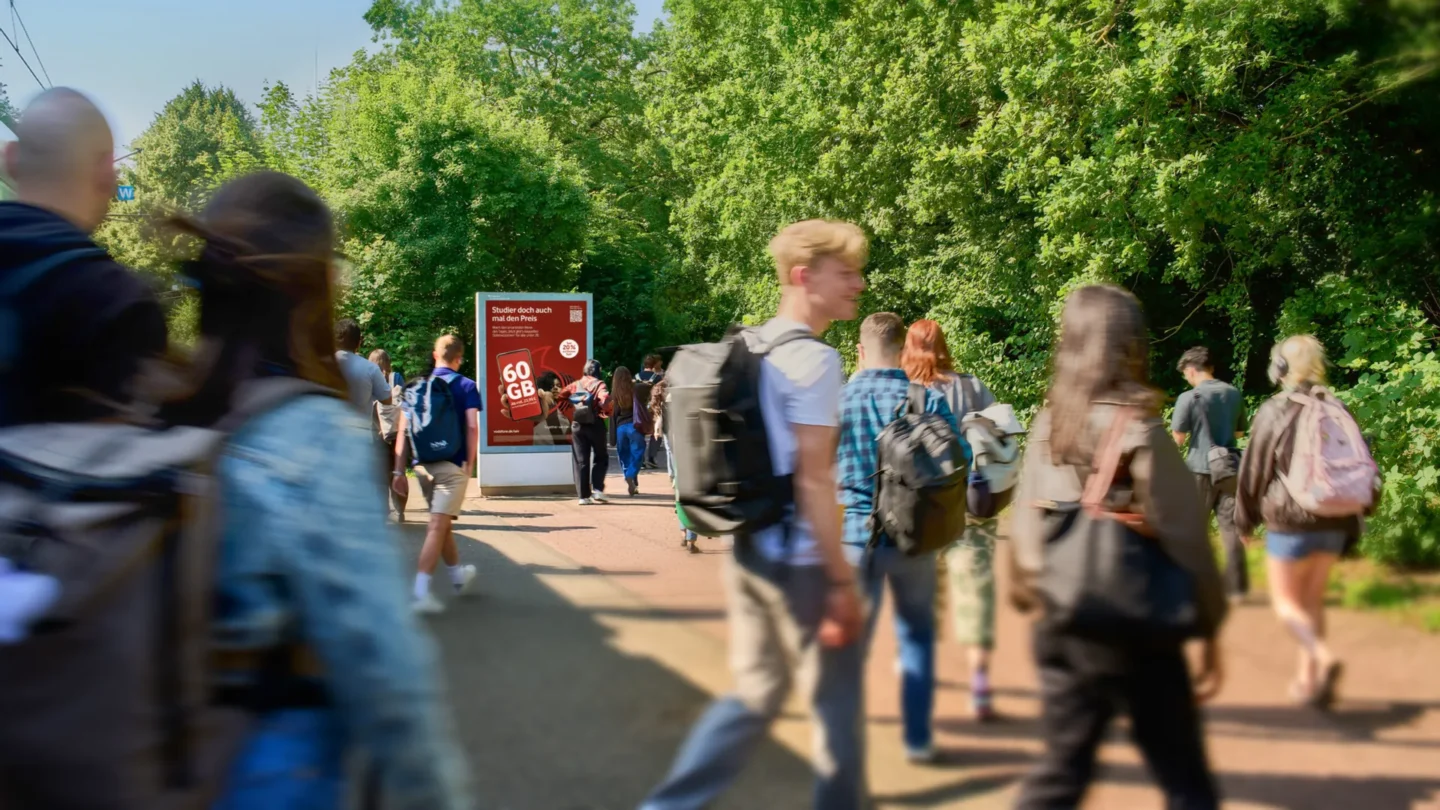
Students are everywhere: at the town festival, in cafés, in the park, online. But there is no place where you can reach this target group with as little wastage as at a university. That is exactly what makes advertising on campus one of the most effective ways to reach young adults between the ages of 18 and 29. Our latest market research, the 2026 Student Barometer, provides concrete figures on the impact of campus advertising.

How effective is campus advertising?
We were interested in this question too, so we asked the young target group directly at university! The result: advertising on campus not only reaches students, it also prompts them to take action. These are the key findings of our latest survey on the impact of higher education marketing:
- 82.7% of students actively notice advertising on campus. The campus is an environment without ad blockers and without the option to skip.
- 72.1%—that is, 7 in 10 students—have already taken action as a result of campus advertising: searched on Google, visited a website, taken part in an activity or made a purchase.
- For 56.7%, advertising on campus is at least as impactful as online or social media advertising.
Source: 2026 Student Barometer.

All survey results
Interested in the results of the Student Barometer? We’d be happy to present the detailed findings of the 2026 Student Barometer and show you how best to reach the student target group.
About the study: target group and methodology
Subject of the study:
The 2026 Student Barometer surveyed students about their consumer behavior, media use and campus life—including their financial situation, planned purchases and provider switches, the influence of student discounts, and the awareness and impact of advertising on campus.
Population:
All students enrolled at the ten participating universities in the summer semester of 2026.
Sample:
n = 555 students. Composition: 55.9% female, 41.6% male, 1.6% diverse, 0.9% not specified; average age 22.4 years (median 22); mostly in the early years of their studies (58.9% up to the 4th semester).
Method:
Quota sampling with quotas for the number of participants to be achieved at each location (not a random sample).
Survey procedure:
Standardized online survey. Interviewers invited students on campus to participate; respondents completed the questionnaire themselves on their own mobile devices using a QR code. Responses were checked for completeness and accuracy.
Survey period:
June 2026.
Survey locations:
Ten large universities distributed across the North, South, East, West and Central regions of Germany: Aachen (RWTH), Berlin (TU), Bonn, Dresden (TU), Frankfurt am Main, Hamburg, Cologne, Leipzig, Munich and Tübingen.
Interpretation:
The survey covers students at ten university locations. Since quota sampling was used rather than random sampling, and no universities of applied sciences (HAW) were included in the sample, the results should not be considered representative of all students in Germany
»The fact that 7 in 10 students have already taken action as a result of advertising on campus shows that campus is not a sideshow in the media mix, but one of the most effective touchpoints for young target groups.
Being present here means not only being noticed, but actually motivating people to take action.«

Areti Karathanasi, �
Managing Director
Deutsche Hochschulwerbung
Discover all the possibilities in higher education marketing!
Your questions about the impact of campus advertising—our answers.
Was ist das Studierendenbarometer?
Das Studierendenbarometer ist eine von der Deutsche Hochschulwerbung konzipierte, durchgeführte und ausgewertete Befragung von Studierenden zu Konsumverhalten, Mediennutzung und Campus-Leben. Es liefert fundierte Zielgruppen-Insights für Hochschulmarketing und Employer Branding.
Wie kann ich die vollständigen Ergebnisse erhalten?
Den ausführlichen Ergebnisbericht des Studierendenbarometers 2026 und der Umfragen in den Jahren davor stellen wir Ihnen auf Anfrage zur Verfügung. Nehmen Sie einfach Kontakt zu uns auf. Wir melden uns mit den für Ihre Kategorie und Zielgruppe relevanten Details.
Wie schneidet Campus-Werbung im Vergleich zu Online- und Social-Media-Werbung ab?
Für 56,7 % der befragten Studierenden wirkt Werbung auf dem Campus mindestens genauso stark wie Online- oder Social-Media-Werbung. Als physischer, nicht überspringbarer Touchpoint ergänzt sie den digitalen Marketing-Mix besonders wirkungsvoll.
Wie viele Studierende nehmen Werbung auf dem Campus wahr?
Laut Studierendenbarometer 2026 nehmen 82,7 % der befragten Studierenden Werbung auf dem Campus aktiv wahr. Der Campus ist ein Umfeld ohne Ad-Blocker, in dem Werbebotschaften nicht weggeklickt oder übersprungen werden können.
Wirkt Campus-Werbung wirklich oder wird sie nur gesehen?
Sie wirkt: 72,1 % der befragten Studierenden – also 7 von 10 – haben aufgrund von Werbung auf dem Campus bereits konkret gehandelt, etwa eine Website besucht, gegoogelt, an einer Aktion teilgenommen oder gekauft.
