
What is student marketing?
What is student marketing?
We briefly explain what student marketing means and provide information on its definition, measures, and how it differs from university marketing.

Student marketing explained!
Definition, measures, and how it differs from university marketing.
Student marketing, also known as marketing to students, encompasses all marketing activities through which companies specifically target students. These include product advertising, employer branding, and recruiting campaigns that reach students on campus, in digital learning environments, and in their everyday student lives. In Germany, this target group comprises around 2.86 million students at more than 260 university locations.*
Would you like to learn more about your options? Feel free to get in touch!
Source: * Federal Statistical Office, winter semester 2024/25

Student marketing and university marketing: What’s the difference?
The terms student marketing and university marketing are often used interchangeably, but they focus on different things:
- Student marketing puts the target audience at the center: students are reached wherever they spend time—on campus, on learning platforms, on social media, or in their free time.
- University marketing refers to activities that use the university as an advertising environment—from poster advertising and DOOH to promotional events.
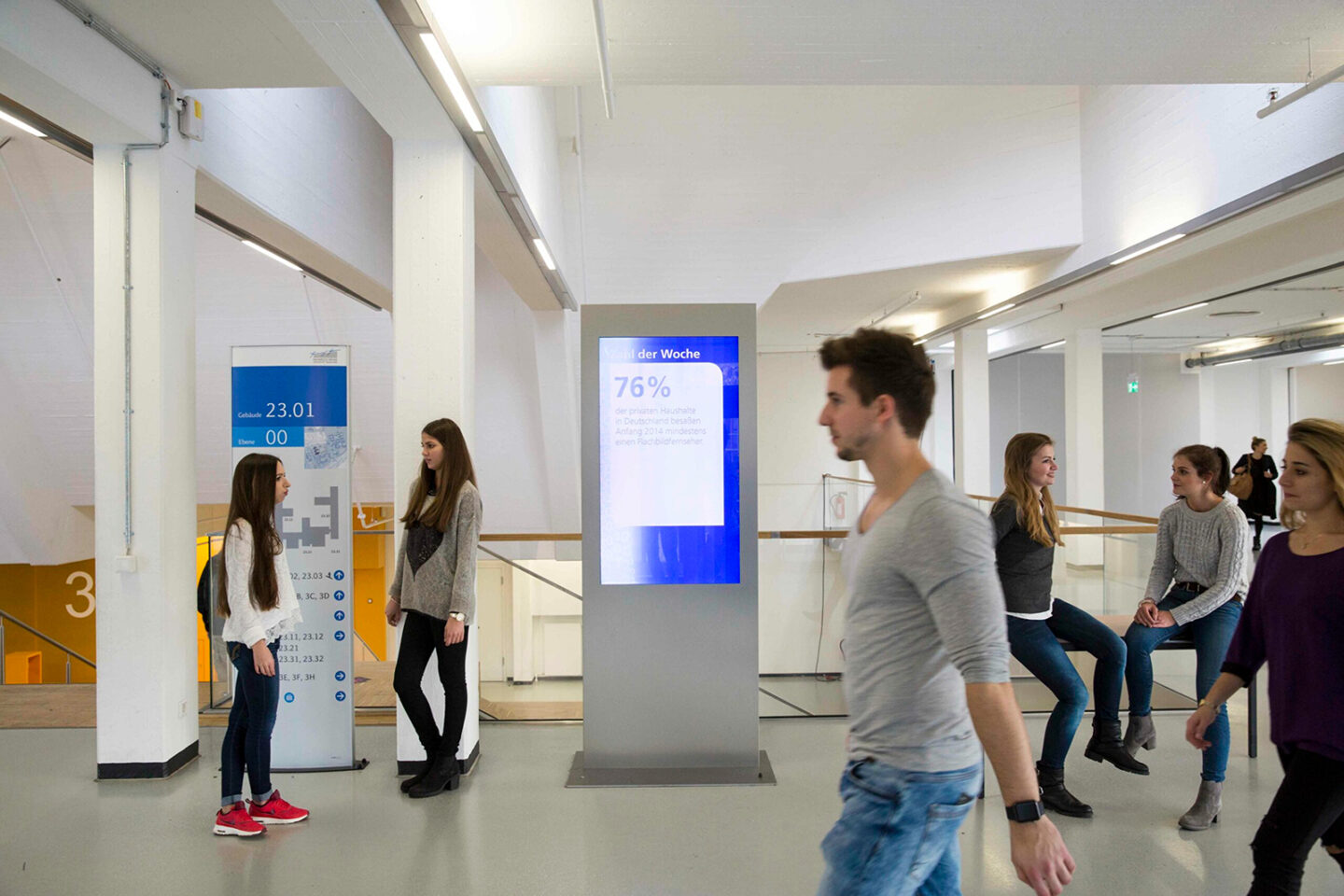
In practice, the two disciplines overlap: successful campaigns combine the focused reach of campus with digital touchpoints in students’ everyday lives. We call this comprehensive communications strategy the 24-hour approach.
What are the most important student marketing measures?
There are many ways to reach students. Our 30 years of expertise have shown us that these are the most important:
- advertising: poster advertising, DOOH on campus screens, and special advertising formats reach students with minimal wastage.
- Direct engagement: on-campus promotions create personal brand experiences and enable sampling and dialogue.
- Digital channels: Advertising on learning platforms or online job boards accompanies students in their daily learning. Influencer marketing enables particularly authentic communication.
Criterion
Student marketing
marketing
Starting point
Location-focused—the university serves as an advertising environment
Target audience-focused—students are reached wherever they spend time
Reach
Campus, learning platforms, social media, leisure activities, student residences—regardless of location
Primarily on university grounds and in the immediate surrounding area
Typical channels
Learning platforms (EdTech), online job boards, influencer marketing, social media
, DOOH on campus screens, promotional events, special advertising formats
Contact quality
Personal, integrated into everyday life, spread across multiple touchpoints
Concentrated, with a high density of contacts in one location
Wastage
Low, as campaigns are specifically targeted—regardless of location
Very low directly at the location, as almost exclusively students are reached
Time flexibility
Can be used year-round, regardless of the academic calendar
Often tied to lecture times and campus opening hours
Main objective
Build brand loyalty, recruit, and develop customer relationships with the target audience
Create visibility and presence where the target audience is most concentrated
Typical application
Employer branding, product communications in students’ everyday lives
Regional campaigns focused on individual university locations
When the distinction matters in practice
Although the two terms are often used interchangeably, distinguishing between them can make a real difference when planning a budget. If your primary focus is students as a target audience—for example, for a nationwide recruiting campaign or a product launch—you naturally think across channels: wastage is minimized across the entire customer journey, not just at a single location. If, on the other hand, you want to build visibility at one or more specific university locations, for example as part of a regional market launch or a local recruiting event, you are more likely to plan in terms of spaces, time periods, and locations—in other words, classic university marketing.
When is each approach worthwhile in student marketing?
For companies recruiting nationwide or offering digital products, it is usually worth focusing on student marketing: students can be reached via learning platforms, job boards, and social media, including in locations where there is no advertising budget for physical spaces on every campus. Employers with strong regional ties, retail chains, or providers based near specific universities, on the other hand, benefit more from classic university marketing—the focus here is on a concentrated local presence, for example through poster advertising, DOOH screens, or promotional events directly on campus.
The gold standard: combining both approaches
In practice, combining the two disciplines delivers the strongest results. Success often comes from three successive steps: a poster campaign or DOOH advertising on campus first generates a high number of initial contacts with minimal wastage—the target audience is reached where they already are. Promotional and sampling activities then create personal brand contact: students can try a product, ask questions, and experience the brand firsthand—an effect that poster advertising alone cannot achieve. In the third step, digital touchpoints on learning platforms, social media, or through influencer partnerships extend the interaction into students’ everyday lives—even outside lecture times and across the academic calendar.
This combination of location-based reach, personal brand experience, and digital engagement in everyday life is what we call the 24-hour approach: students are reached not just in one place, but throughout the day at the touchpoints most relevant to them—from their first encounter with a brand on campus to a deeper engagement with it in their digital everyday lives.
Is student marketing worthwhile for companies?
Student marketing is most successful when it takes students’ lives seriously. Companies should therefore focus on relevant content, credible messaging, and a presence at the right touchpoints. This applies to advertising on campus, online, and at students’ leisure activities.
- Target audience with significant purchasing power: Students have an average of EUR 1,196 per month.**
- Early brand loyalty: Many purchasing decisions and brand preferences are formed for the first time during university—being present now means winning tomorrow’s customers.
- The skilled professionals of tomorrow: Around 501,000 graduates leave universities each year—making student marketing a key tool for employer branding as well.
- Low wastage: The target audience can be reached in a concentrated way on campus; the university touchpoint has the highest affinity score among 14–29-year-olds.***
Sources: ** Social Survey 22 (2023)
*** Public & Private Screens 2.0 (2025)
Clarifying the terminology: student marketing, university marketing, E14+ and the 14–29 target audience
Alongside “university marketing” and “student marketing,” companies often encounter two other terms in media planning: E14+ and the 14–29 target audience. Both come from traditional target audience definitions and help put your own approach into context.
E14+ stands for “adults aged 14 and over” and is the classic, open-ended target audience definition used in media planning—it encompasses practically the entire advertising-relevant population from their teenage years onward. For companies seeking to reach young people specifically, E14+ is usually too broadly defined: it also includes audiences that are not relevant to their campaign.
This is where the 14–29 target audience comes in: it narrows the broad E14+ definition to the period from puberty to the start of a career—that is, school students, university students, and young professionals. Within this age range, university marketing covers the core group, as students (around 18–29 years old) make up the largest and most precisely targetable part of this audience. Student marketing, as explained above, refers to the measures universities themselves take to attract prospective students, and should therefore be distinguished from the other two terms.
In practice, this means that companies seeking to reach the entire 14–29 target audience combine university marketing for students with complementary formats for the younger 14–17 segment—and avoid the wastage of relying solely on E14+ planning.
Explore campus advertising opportunities now!
FAQ on student marketing
Still have questions about student marketing? We answer the most frequently asked questions in our student marketing FAQ.
Für welche Branchen eignet sich Studentenmarketing besonders?
Studentenmarketing eignet sich für nahezu alle Branchen, die Studierende als Konsument:innen oder künftige Fachkräfte ansprechen möchten – von Finanzdienstleistern über Konsumgüterhersteller bis zu Technologieunternehmen. Besonders wirksam ist es im Employer Branding sowie für Marken, die frühzeitig Markenbindung bei der jungen Zielgruppe aufbauen wollen.
Lassen sich Studentenmarketing und Hochschulmarketing kombinieren?
Ja, in der Praxis liefert die Kombination beider Disziplinen die besten Ergebnisse. Werbung auf dem Campus sorgt für hohe Erstkontakte mit minimalem Streuverlust, digitale Kanäle verlängern die Kontaktstrecke danach in den studentischen Alltag hinein. Diese Verzahnung bezeichnen wir als 24-Stunden-Ansatz.
Wann eignet sich Studentenmarketing besser als Hochschulmarketing?
Studentenmarketing eignet sich besonders für Unternehmen mit bundesweitem Recruiting-Bedarf oder digitalen Produkten, da sich die Zielgruppe auch über Lernplattformen, Jobbörsen und Social Media erreichen lässt – unabhängig vom einzelnen Hochschulstandort. Hochschulmarketing lohnt sich dagegen für Unternehmen, die an bestimmten Standorten sichtbar werden möchten, etwa regionale Arbeitgeber oder Filialisten.
Was ist der Unterschied zwischen Studentenmarketing und Hochschulmarketing?
Studentenmarketing stellt die Zielgruppe der Studierenden in den Mittelpunkt und erreicht sie überall dort, wo sie sich aufhalten – auf dem Campus, digital oder in der Freizeit. Hochschulmarketing nutzt dagegen den Ort Hochschule selbst als Werbeumfeld, etwa durch Plakatwerbung, DOOH-Screens oder Promotionaktionen vor Ort. In der Praxis werden beide Ansätze meist kombiniert.
Was ist der Unterschied zwischen Studentenmarketing und Studierendenmarketing?
Es gibt keinen inhaltlichen Unterschied. Studierendenmarketing ist die gendergerechte Bezeichnung für Studentenmarketing. Beide Begriffe beschreiben Marketingmaßnahmen, die sich an Studierende richten.
Was kostet Studentenmarketing?
Die Kosten variieren stark nach Medium, Standort und Laufzeit. Einen Überblick über Preisfaktoren oder ein individuell auf Ihre Kampagne abgestimmtes Angebot stellen wir Ihnen gerne zur Verfügung. Kontaktieren Sie uns dafür unverbindlich.
Welche Kanäle funktionieren im Studentenmarketing am besten?
Am wirksamsten ist ein Marketing-Mix: Werbung auf dem Campus (Plakat, DOOH, Promotion) erzielt hohe Aufmerksamkeit bei minimalem Streuverlust, digitale Kanäle wie Lernplattformen und Social Media verlängern die Kontaktstrecke in den studentischen Alltag.
Wie lässt sich der Erfolg von Studentenmarketing messen?
Übliche Kennzahlen sind Reichweite und Kontakte auf dem Campus, Klick- und Interaktionsraten bei digitalen Kanälen sowie recruiting-relevante KPIs wie Bewerbungen oder Traffic auf Karriereseiten. Welche Kennzahlen im Detail sinnvoll sind, hängt vom Kampagnenziel ab – wir beraten Sie gerne zu einem passenden Messkonzept.
